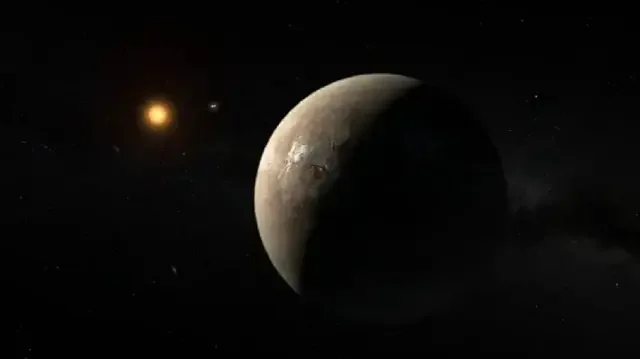
Astronomers have identified a promising Earth-sized planet candidate that could potentially support life, located just 146 light-years from Earth. The planet, known as HD 137010 b, orbits a star similar to the Sun and is approximately six percent larger than Earth, making it one of the closest potentially habitable exoplanet candidates discovered so far.
The discovery was made by an international team of scientists using data collected in 2017 by NASA’s Kepler space telescope. HD 137010 b completes one full orbit around its host star in 355 days, closely matching the length of an Earth year, which adds to its scientific significance.
Researchers highlighted the importance of the planet’s proximity, noting that its host star is among the nearest known stars with an Earth-sized planet in the habitable zone. Compared to other similar candidates, this system is considerably closer, increasing future opportunities for detailed observation and study.
The planet’s discovery has a unique backstory, as the initial signal was first noticed by lead author Alexander Venner while he was still a high school student taking part in a citizen science project. Follow-up analysis years later confirmed the signal’s importance, turning an early observation into a major scientific finding.
Although HD 137010 b lies within the habitable zone, its star is slightly cooler than the Sun. As a result, scientists believe the planet’s surface temperature could be more comparable to Mars, with conditions possibly dropping below minus 70 degrees Celsius. This raises the possibility that the planet may be a frozen world rather than a warm, Earth-like environment.
Experts caution that the planet remains a candidate because it has been observed transiting its star only once. Additional observations are required to confirm its existence and better understand its atmosphere and surface conditions. Some scientists speculate that it could be a large icy planet with frozen water, often described as a “super snowball.”
Despite its relatively close distance in astronomical terms, reaching the planet would still be far beyond current human capabilities, potentially taking tens of thousands of years with existing technology. The research team has published their findings in the Astrophysical Journal Letters, marking an important step forward in the search for nearby Earth-sized planets.