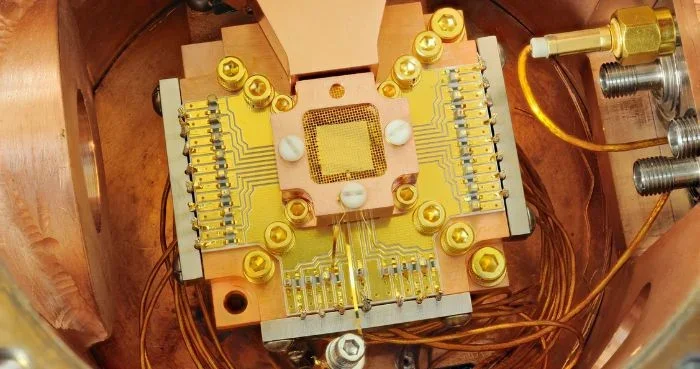
Russia has unveiled its first domestically developed ion-based quantum computer, marking a significant advancement in the country’s quantum technology capabilities. The system, created by scientists at the Russian Quantum Center (RQC), uses a novel multi-level quantum architecture featuring seven energy levels per unit, making it comparable in power to a 72-qubit quantum processor. This design enables the machine to perform complex calculations with exceptional precision.
Maxim Ostras, head of the RQC, explained that researchers began experimenting with multi-level quantum units in 2021 using a smaller prototype. Over four years, the team expanded the system’s computational power to create the current prototype equivalent to 72 qubits, showcasing rapid progress in domestic quantum computing.
Unlike traditional quantum computers that rely on standard two-level qubits—analogous to classical bits—this system employs more complex units capable of storing and processing more information with fewer particles. While these multi-level systems increase computational capacity, they are significantly more challenging to control.
Russia’s quantum computer uses 26 calcium ions, each functioning as a seven-level quantum unit capable of representing values from zero to six. To build the system, RQC scientist Kirill Lakhmanskiy and his team developed specialized laser technology and a sophisticated optical setup, allowing precise control over quantum states and execution of basic logical operations.
The processor has achieved record accuracy for a quantum system of this size, with 99.92 percent accuracy in single-qubit operations and 96.5 percent for two-qubit operations. Lakhmanskiy noted that the team plans to use the computer for combinatorial optimization algorithms, which have applications in network design, logistics, and other complex problem-solving scenarios.